Last summer I let Google’s CP-SAT solver crack Sudokus in fractions of a second. Deeply satisfying. Educational? Not really. The solver learned nothing, and neither did I. It just knew.
That is also my problem with every Sudoku app I have tried. You get stuck, you tap “hint”, and the app says: “Row 4, column 7 is a 3.” Thanks. That is not a hint, that is a spoiler with extra steps. What I wanted was a coach. Someone who leans over my shoulder and says: “You keep scanning for singles. Have you looked at what the 8 is doing in block 7?” And only if I am still lost, a bit more. And only at the very end, the full explanation.
So the requirements wrote themselves:
- A solver that thinks in human strategies, not in backtracking, and hands out hints in escalating doses.
- A trainer mode that makes me check the rules in the right order until it becomes a habit.
- A generator for puzzles of six difficulty levels, plus a validator for puzzles I type in from the newspaper.
- And, as always on this blog: one HTML file, zero dependencies. Double-click, play.
I built it using Claude Code (Fable 5.1). I brought the requirements, the stubbornness about the one-file rule and a lot of “no, the hint is still too explicit”. Claude brought eighteen solving techniques, a test suite that caught its own bugs, and the patience to explain a Swordfish in German. More on that below.
Some Sudoku Facts to Ruin Your Next Dinner Party
- The puzzle is not Japanese. It was invented by Howard Garns, a retired architect from Indiana, and appeared as “Number Place” in a Dell puzzle magazine in 1979. The Japanese publisher Nikoli picked it up in 1984 and named it Sūji wa dokushin ni kagiru, “the digits must remain single”. Mercifully shortened to Sudoku.
- The ancestor is older still: Leonhard Euler wrote about Latin squares in 1782. A Sudoku is a Latin square with the extra 3×3-box rule bolted on.
- There are 6,670,903,752,021,072,936,960 valid filled grids (Felgenhauer and Jarvis, 2005). If you count grids that are the same up to rotation, reflection and relabelling only once, 5,472,730,538 remain. Still enough for a few lifetimes of Sunday mornings.
- A puzzle needs at least 17 clues to have a unique solution. Nobody has ever found a valid 16-clue puzzle, and in 2012 McGuire, Tugemann and Civario proved there is none, with an exhaustive search that burned millions of CPU hours. About 49,000 different 17-clue puzzles are known.
- Sudoku on a general n²×n² board is NP-complete (Yato and Seta, 2003). On the 9×9 board that is a purely theoretical threat; my phone solves any of them before the screen finishes fading in.
- In 2012 the Finnish mathematician Arto Inkala published what he called the “world’s hardest Sudoku“. I typed it into the validator. Verdict: Level 6, extreme, trial and error required, five times. Good to know the app and the newspapers agree on something.
The App in Ninety Seconds
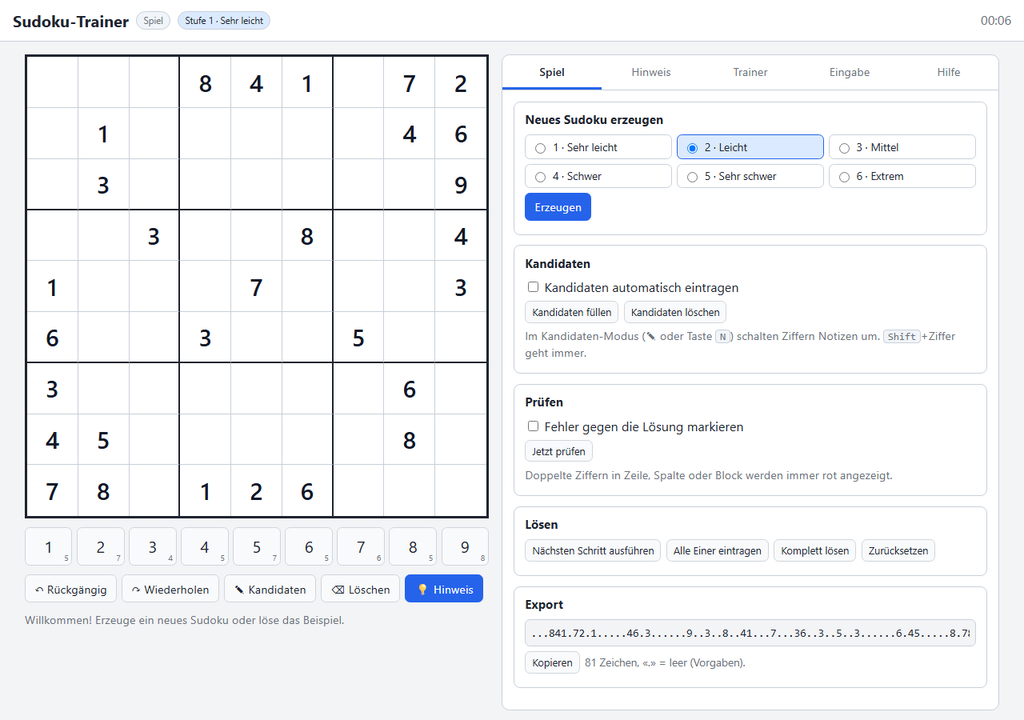
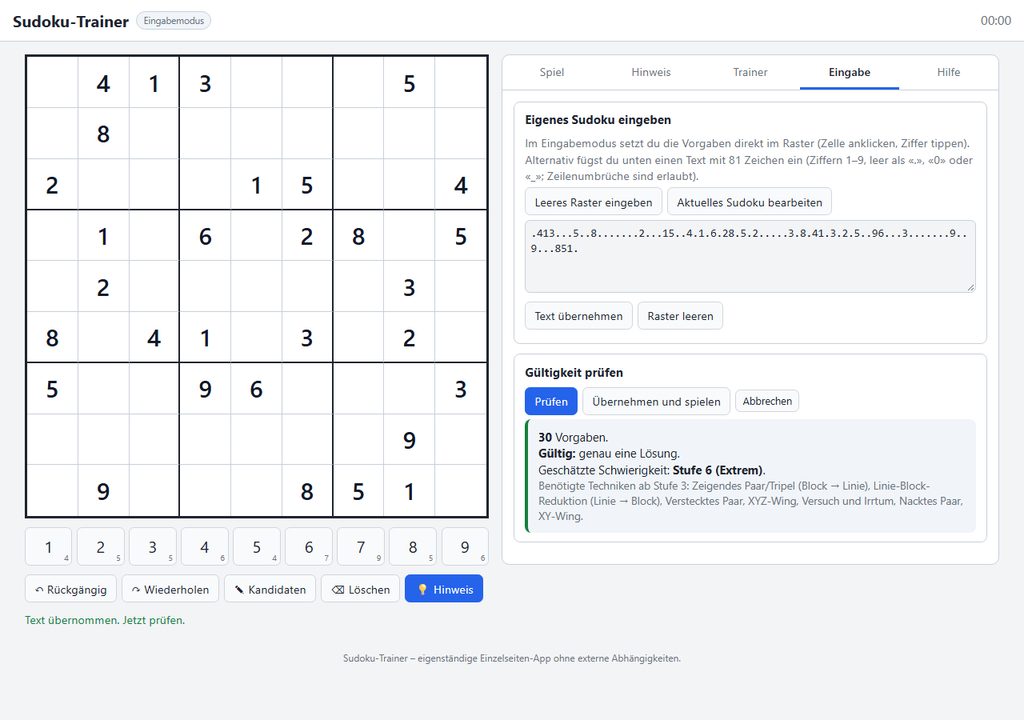
Everything lives in one file, 95 KB, no framework, no CDN, no server. The sourcecode can be found on my github account here. Your progress is saved in the browser’s local storage and nowhere else.
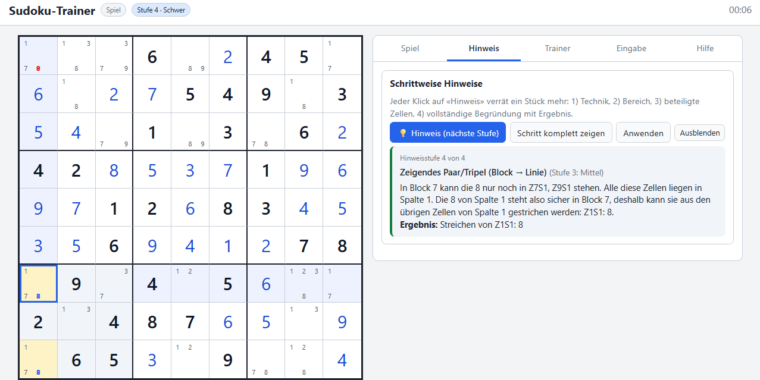
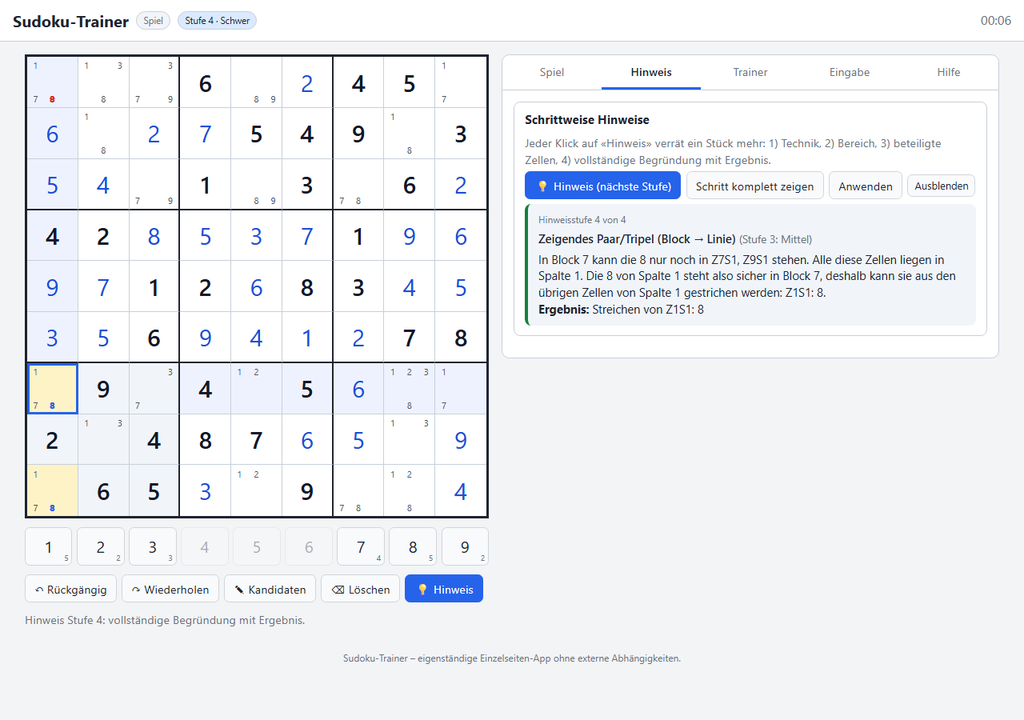
Hints come in four doses. The first click only names the technique (“this is a job for a hidden single“). The second points at a region (“look at the 8 in block 7”). The third highlights the cells involved. Only the fourth click spells out the full argument and offers an “apply” button. If there is a mistake on the board, the hint engine refuses to help until you find it, again in four doses, from “something is wrong” down to the exact cell.
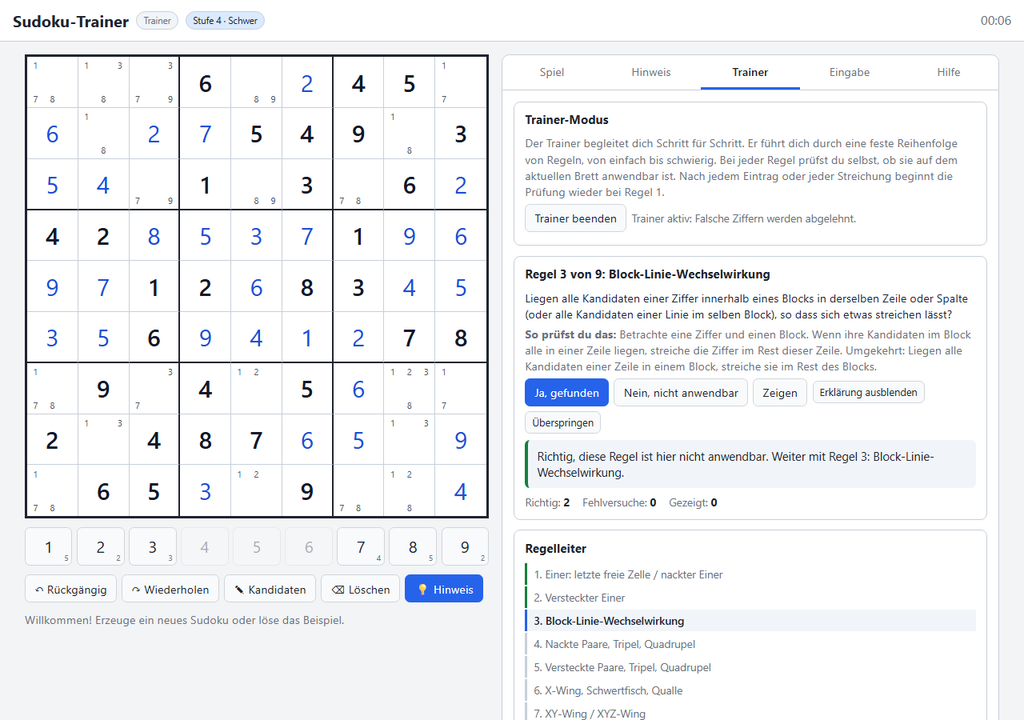
The trainer mode is the part I actually wanted. It walks you through a fixed ladder of nine rule groups, from “any cell with a single candidate?” up to “time to try and fail”. At each rung you answer: yes, this rule applies here, or no, it does not. Say “no” when it does apply, and the trainer gently disagrees and gives you a nudge. Say “yes” and you have to click the cell and enter the digit yourself. Wrong digits are rejected with a reason. And after every single change on the board, the ladder resets to rung one, because that is exactly the discipline I keep failing at: after every placement, look for the cheap stuff first.
The generator produces puzzles in six levels, from “only naked singles” to “no known technique suffices”. The validator takes 81 characters, tells you whether the puzzle has zero, one or several solutions, and rates its difficulty. All in the browser, in well under a second.
For the Curious: Why Generating Sudokus Is Harder Than Solving Them
Backtracking, the boring hero
The fast solver is textbook backtracking with two tricks that make it fast enough to run thousands of times per second in JavaScript. First, bitmasks: for each row, column and box a 9-bit integer remembers which digits are taken. Second, most constrained cell first: always fill the cell with the fewest candidates. If a cell has exactly one candidate, there is nothing to guess; if it has zero, back up immediately. A full random grid takes about a millisecond. Counting solutions works the same way, except you stop at two, because “unique” is the only question that matters.
The human solver is the real product
The backtracker knows that a cell is a 3. It has no idea why. For hints, you need a second solver that plays like a person: naked and hidden singles, pointing pairs, naked and hidden subsets, X-Wing, Swordfish, Jellyfish, XY- and XYZ-Wing, simple colouring, and, as the last resort, bifurcation. Eighteen techniques, sorted from cheap to expensive. Every technique returns a step: the cells involved, the eliminations or placement, and a German explanation with the reasoning. The four hint levels are just four views of the same step object. The trainer asks the same solver “show me all instances of rule group 3″ to check whether your click hit a real one.
Correctness matters here more than anywhere. A hint that eliminates the right digit is not a hint, it is sabotage. So the test suite solves random puzzles step by step and checks every placement and every elimination against the known solution. Over 22,000 steps, zero errors. The suite also caught a genuinely embarrassing bug on the first run: `Array.from({length: 81}, i => …)` hands you the *value* (undefined), not the index, so every cell had `NaN` peers. Sudoku without peers is very easy and very wrong.
Difficulty is whatever the human solver had to do
How hard is a puzzle? The honest answer is: as hard as the hardest technique the human solver needed on the way to the solution. Because the techniques are tried cheapest first, this is reproducible, and it gives a natural six-level scale.
The generator’s dirty secret
Generating a puzzle is easy: take a full grid, remove clues while the solution stays unique, stop when nothing more can go. Generating a puzzle of a given difficulty is where it gets interesting. I measured what random minimal puzzles actually look like:
| Hardest technique needed | Share of random puzzles |
|---|---|
| Hidden single | 60 % |
| Trial and error | 15 % |
| Only singles | 8 % |
| XY-/XYZ-Wing, colouring | 8 % |
| Box-line interactions | 7 % |
| Naked or hidden pair | 1.5 % |
| X-Wing or triple | 0.1 % |
Random Sudokus are mostly boring, occasionally brutal, and almost never “pleasantly hard”. My first level 4 was defined as “triples or X-Wing” and the generator found exactly zero of them in 150 attempts. So two things changed. XY-Wing and XYZ-Wing moved down to level 4, which is where most Sudoku literature puts them anyway. And the carving got a difficulty ceiling: a clue may only be removed if the puzzle stays unique *and* the rating does not exceed the target level. That pushes every puzzle to be as hard as possible without overshooting, and it lifts the hit rate for level 4 from zero to a workable seven percent. At two to three milliseconds per attempt, that is a sub-second wait, with a spinner for the unlucky cases.
One more hurdle I did not see coming: hints must reason about the candidates you see, not about the candidates the machine computes from scratch. Otherwise, after you apply a naked pair, the engine recomputes everything, rediscovers the same naked pair and proposes it again. Forever. The fix is a one-liner conceptually and a surprising amount of state management in practice.
Try It
The whole thing, including the human solver, the trainer ladder, a Node test suite and a benchmark script, is on GitHub. MIT licensed. Download ‘index.html’ and open it or just start this file, and let the trainer nag you about checking for singles first. It is right, you know.